
Weekly Market Recap – Week Ending Jun 12, 2026
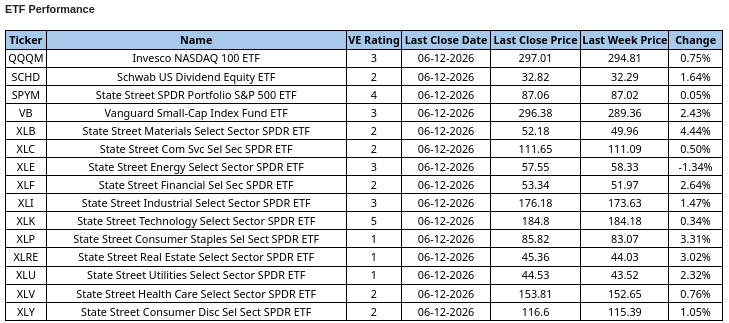
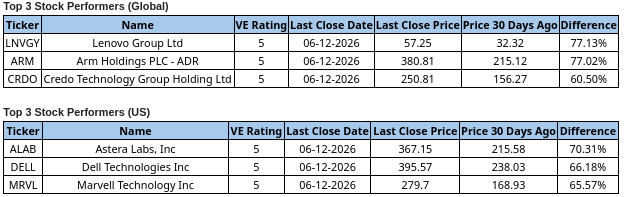
U.S. equity markets recovered this week, with gains broadening across most major ETFs and sector benchmarks. The S&P 500 ETF (SPYM) was nearly flat with a modest 0.05% gain, while the NASDAQ 100 ETF (QQQM) rose 0.75% and Small Caps (VB) advanced 2.43%, signaling improved market breadth. Sector leadership was led by Materials (XLB), Consumer Staples (XLP), Real Estate (XLRE), Financials (XLF), Utilities (XLU), and Industrials (XLI), while Energy (XLE) was the only sector ETF in the list to decline. Stock-specific momentum remained especially strong in technology, semiconductor, and AI infrastructure names, with Lenovo Group (LNVGY), Arm Holdings (ARM), Astera Labs (ALAB), Dell Technologies(DELL), Marvell Technology (MRVL), and Credo Technology (CRDO) posting sharp 30-day gains.
Trade ValuEngine supported portfolio strategies, www.ValuEngineCapital.com
Strategy Note:
The long-awaited initial public offering of Space Exploration Technologies Corp. (SPCX) completely dictated capital flows and market sentiment this past week. Pricing late Thursday was at $135 per share. The historical $75 billion capital raise—the largest in global history—culminated in a spectacular Friday debut on the Nasdaq Global Select Market. SPCX opened at $150, surged as high as $176.52, and closed its first day of trading up 19.34% at $161.11, pushing its market capitalization past $2.1 trillion and cementing its position as the sixth-largest U.S. company.
A widely shared narrative across trading desks this week was the “Tech Liquidation Theory”—the belief that institutional and retail investors aggressively sold existing mega-cap technology shares to carve out liquidity for the massive SPCX capital call.
This theory was validated by the trading mechanics of the Invesco QQQ Trust (QQQ). Daily flows and returns for the QQQ showed increased pressure mid-week during peak IPO bidding, followed by an afternoon rebound on Friday as the market digested the initial launch:
Monday (06/08): +0.15% | -$450M net outflow (Early positioning)
Tuesday (06/09): -0.85% | -$1.2B net outflow (Liquidation accelerating as orders top $250B)
Wednesday (06/10): -1.10% | -$2.4B net outflow (Peak pre-funding cash allocation)
Thursday (06/11): +0.20% | -$900M net outflow (Pricing locked at $135)
Friday (06/12): +0.30% | +$1.1B net inflow (Retail/Institutional buying after missing direct allocation)
On Friday, SPCX’s single-stock volume topped $33 billion, significantly eclipsing QQQ‘s total daily dollar volume of roughly $22 billion, proving that the rocket ship effectively hijacked the entire tech tape.
Considerable attention was paid to closed-end funds and pre-IPO ETFs that already held private positions in SpaceX . These funds saw massive premium expansions early in the week before experiencing a “sell-the-news” reversion on Friday as direct equity access became live.
The launch triggered a sharp divide among high-profile exchange-traded fund sponsors and portfolio managers. Most transparent were ARK Invest and ProShares. Each firm’s spokesperson declared they would aggressively buy SPCX on the open market and deploy capital into “the ultimate AI infrastructure play.”
Conversely, conservative index fund sponsors and managers tracking S&P 500-based mandates stated they will not touch the stock yet. They point to S&P’s strict criteria requiring four consecutive quarters of cumulative GAAP profitability—a hurdle the cash-burning SpaceX (which posted a $4.94 billion GAAP net loss in 2025) fails to meet. Moreover, Keith Snyder, senior analyst at CFRA Research, led the bears by issuing a Sell rating and a $115 price target. Snyder labeled the implied growth levels required to back the $1.77Trillion valuation within its AI and satellite segments as “astronomical, kind of borderline comical.” Morningstar echoed this skepticism, pinning SPCX’s fundamental fair value at just $63 per share or $780 billion. In a timely podcast, David Trainer’s quantitative analytics firm New Constructs (www.NewConstructs.com) detailed its accounting-based analysis on why the IPO has been grossly overpriced and why prudent investors should avoid the IPO. For our part, ValuEngine is neutral and will remain so until at least one-year of full financials are available. This is our process and it cannot and will not be altered, no matter how compelling the investment case might be for a company that has no previous publicly audited financials available
On a more positive note, two major space-themed ETFs operated under index rules requiring fast-track, mandatory inclusion of SPCX on its first day of trading: the VanEck Space ETF (WARP) and the Procure Space ETF (UFO). This short table may be helpful to our readers.
| ETF Name | Ticker | Description | Expense Ratio | Prior Week Price Change |
| VanEck Space ETF | WARP | Tracks the Market Vector Space Index, providing pure-play exposure to launch, satellite infrastructure, and space data. | 0.55% | -9.48% (Severe drag from forced liquidity sales) |
| Procure Space ETF | UFO | Tracks the S-Network Space Index, focusing heavily on satellite-based communications and aerospace components. | 0.75% | -7.00% (Selling pressure ahead of Friday rebalancing) |
To fund their massive Day-One mandates for SPCX, both WARP and UFO were forced to liquidate portions of their core legacy holdings. The top three stocks include: Rocket Labs USA (RKLB) with a market capitalization of $10 billion, AST SpaceMobile (ASTS, $8 million mkt. cap); and EchoStar Corporation (SATS, $ 3 Billion). All three are rated 5 (Strong Buy) from ValuEngine. However, those ratings are strictly data-based and the order flow dynamics last week marched to its own speculation-fueled drummer.
The biggest victim was SATS, down 11.6%. Its legacy satellite business is considered most vulnerable to SPCX and Starlink. Rocket Labs (RKLB) got positive midweek speculation that quickly reversed Thursday and Friday as capital rotated out of mid-cap launch providers directly into SPCX,, leaving RKLB investors with an 8% loss for the week. It was a different story entirely for AST SpaceMobile (ASTS). The stock rose 12%, surging on massive options volume ahead of Friday, buoyed by the thesis that SpaceX’s space-based data center narrative validates ASTS’s cellular satellite network infrastructure.
We will cover the effect on this launch on the equity markets in more detail in a special full blog that is expected to be available in the middle of next week. One subject we’ll provide insights on is the extent to which broad index investors are being forced to buy SPCX as a result of exceptions being made by the index providers to cover this unprecedented launch. A spoiler alert is that Standard & Poor’s decided to leave their venerable rule book unchanged.
www.ValuEngine.com (
www.ValuEngineCapital.com (
BLOG.VALUENGINE.COM for the full history of ValuEngine.com financial blog posts
____________________________________________________________________________
5,000 stocks, 600 ETFs, 16 sector groups, and 140 industries updated on www.ValuEngine.com
Full Two Week Free Trial HERE
Financial Advisory Services based on ValuEngine research and Portfolios available through www.ValuEngineCapital.com